How to translate the word oberih. The internet tells me amulet, talisman, charm, guardian. I like the word amulet.
Embroidered amulets (pleural oberehy) have gained a lot of attention in Ukraine in the last three-and-a-half years and for obvious reasons. They are believed to offer protection and can be present in the main design on an embroidered shirt, or sewn as a separate symbol nearby a seam or on a collar. They can be embroidered as a whole motif onto a cloth worn somewhere on one’s person, like a mini-scarf in a pocket. I’ve also been told that the boys, the defenders, are asking that they be backed with Velcro, which would make them like a chevron, worn as a patch on the uniform/camouflage. For me, this concept epitomizes one of the ways in which the traditional is being brought into the hyper-contemporary in this current moment (all three-and-a-half years of it) in Ukrainian history and society.
I’ve referenced it in a previous post, but if you didn’t pick it up, visit #сорочкадлязахисника (shirt for a defender) in Facebook or on Instagram. This is a grassroots project in which women around Ukraine and abroad are embroidering bespoke shirts for defenders, using khaki fabric to go with military kit and designs imbued with the powers of protection, adding embroidered patches of brigades or the Ukrainian flag onto sleeves. It’s a wonder of a movement, breath-taking to behold, even from this distance. To me, it symbolizes Ukrainians’ connection to heritage, this utter conviction that embroidery is OUR CODE, the significance of the embroidered Ukrainian shirt and the way in which people throughout Ukrainian society understand that they all have something to contribute. Behold and be inspired.
I certainly have been. I saw a call to embroider oberehy for our defenders on the front lines and from the resources being shared, I took this design, which hails from the Hadiats’k region of the Poltava Oblast’, north eastern Ukraine.
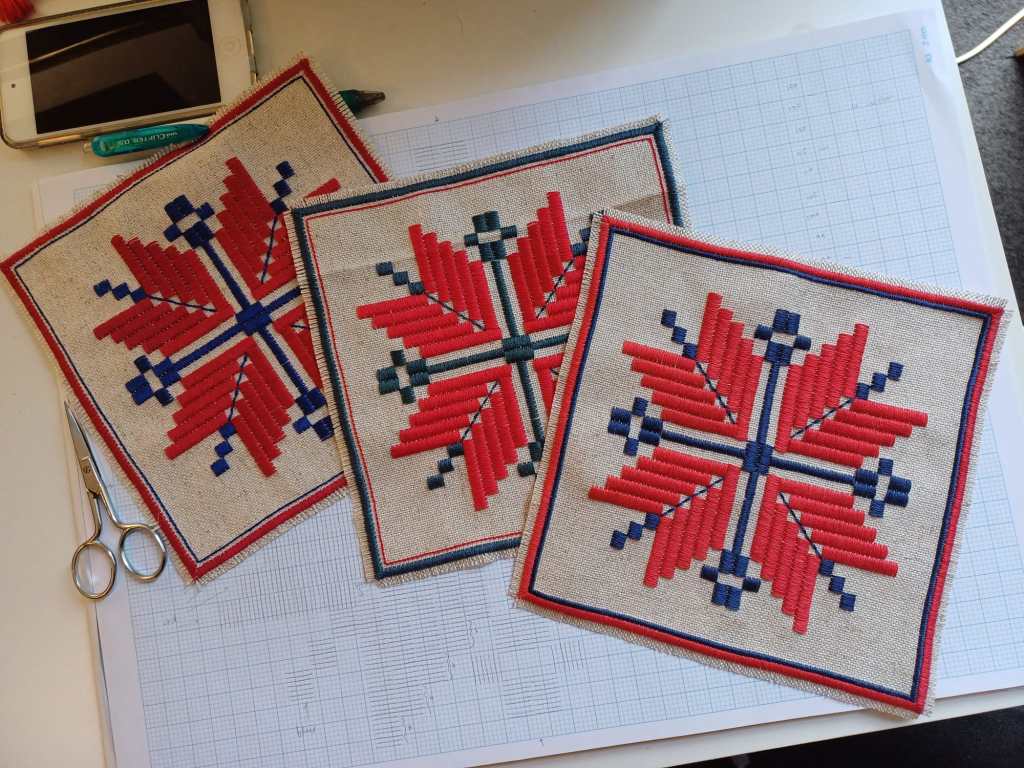
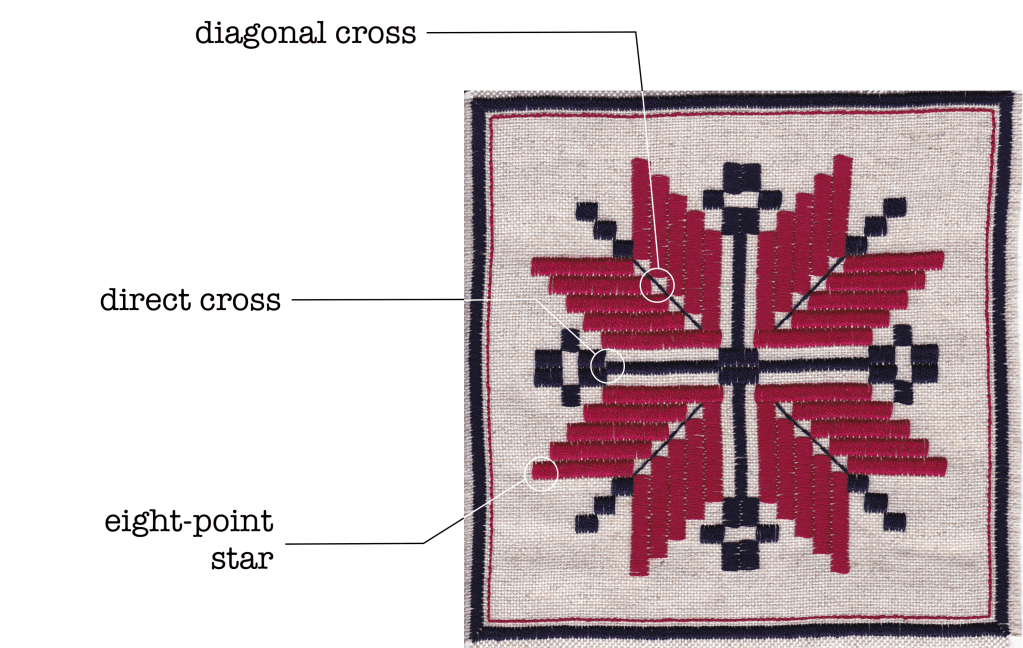
There are several motifs that are believed to offer protection. In this design, you see three of them. I’m translating a bit literally when I call them the direct cross (horizontal and vertical components) – прямий хрест – and the diagonal cross – косий хрест. The eight-point star is also a protective motif. Whilst embroidery varies incredibly vastly throughout different regions, direct and diagonal crosses and eight-point stars are ubiquitous.
You may or may not have seen Ukrainian embroidery in black and red. Did you know that before the development in Europe of alanine dyes, which were used to produce black threads, these designs were in fact blue and red? The blue was indigo blue and came to Ukraine from India!
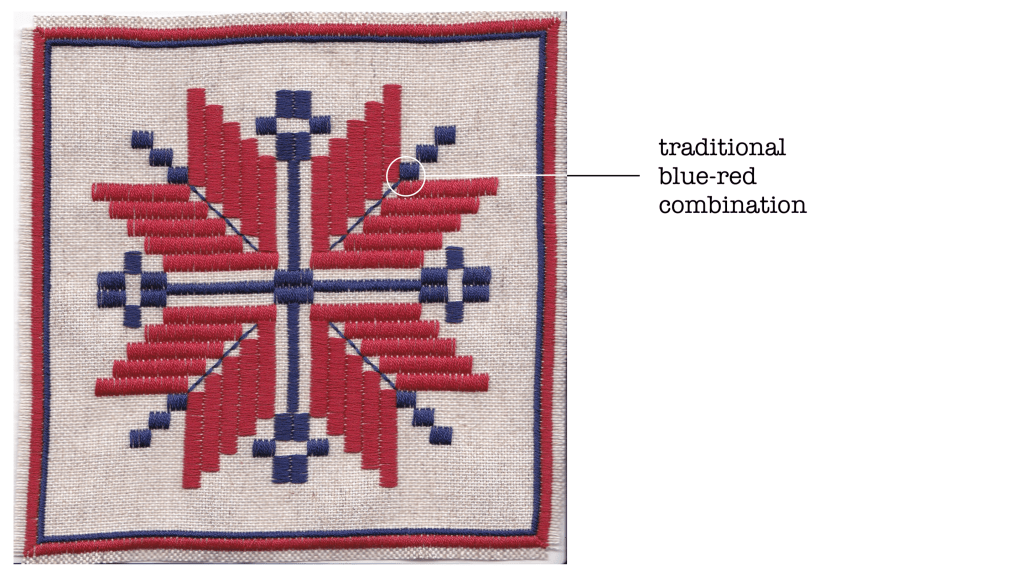
And in the same way that motifs carry meaning in Ukrainian embroidery, so do colours. In Ukrainian worn embroidery (тілесна вишивка), red is literally used as protection against foreign influences onto the body of a person and against curses and witchcraft. Blue and red in combination are harmonizing.
These oberehy were the mini-scarf (хусточка) in a pocket kind. Let me show you their key characteristics as amulets.
And what is with the edges?
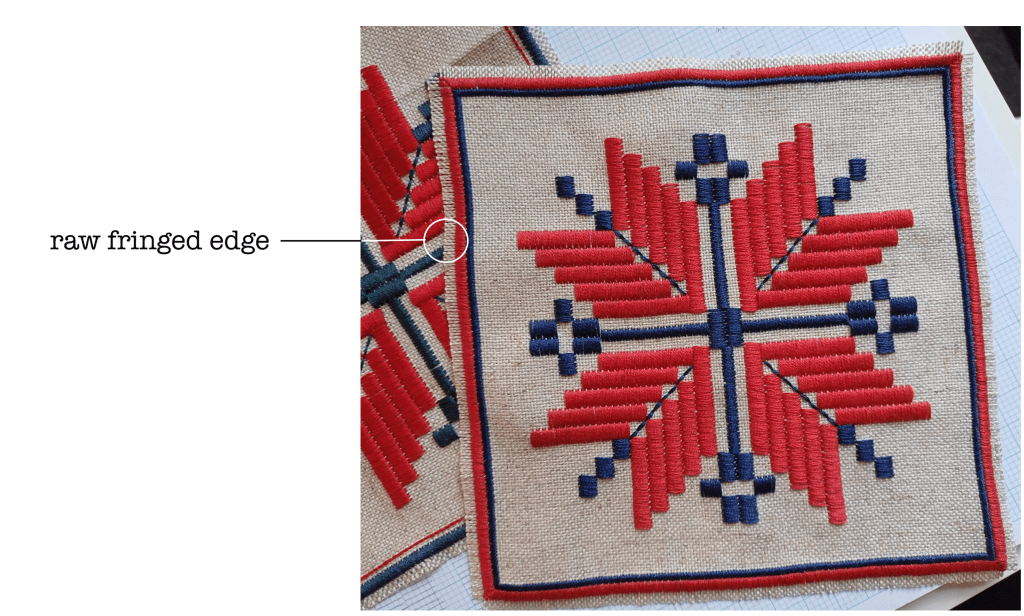
Embroidered amulets are deliberately left with an unhemmed, raw fringed edge. This allows all the power of these small pieces to flow from them and into the bodies of those who carry them, who wear them on their person.
Of course, I took the opportunity of making these to have myself some colour play. And not only with the shades of blue and red, but I also named them in ways that I hoped would bring some smiles and warmth to Ukrainians, after quintessential symbols from Ukrainian life or culture.

On a more serious note: I finished these oberehy over a year ago and sent them to Ukraine, to someone who could send them on to the frontline. May they be continuing to do their work, protecting the defenders who received them.
~oOo~
 KX Beautiful Ukrainian Embroidery